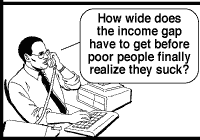
They wouldn't take a deal that would have cut the accumulation of debt by anywhere from 2.7 to 4 trillion, so instead we get this. If they hate taxes so much, why do they want us all to pay higher interest on everything?
Obama could win and lose at the same time, striking a deal to avoid default but failing to pass muster on the substance of that deal with credit agencies, which could go ahead and downgrade the rating anyway.
~
Showing posts with label it's wartime - we all have to sacrifice (unless you're a plutocrat). Show all posts
Showing posts with label it's wartime - we all have to sacrifice (unless you're a plutocrat). Show all posts
Wednesday, July 27, 2011


Friday, June 19, 2009
Tuesday, October 28, 2008
from the LoC archives: a short recent history of redistribution of wealth

March 12: According to the latest available statistics from the Internal Revenue Service, the top 1 percent of Americans earned significantly more income in 2005 than the bottom 50 percent. In addition, the Congressional Budget Office (CBO) recently reported that the wealthiest 1 percent saw total income rise by $180,000 in 2005. That is more than the average middle-class family makes in three years. The CBO also found that the total share of after-tax income going to the top 1 percent hit the highest level on record, while the middle class and working families received the smallest share of after-tax income on record.
May 5: The gap between rich and poor in the United States has widened exponentially over the past three decades. The Congressional Budget Office reports that since 1979, the average income for the bottom half of American households has grown by 6 percent. In contrast, the top 1 percent of earners have seen their incomes shoot up by a 229 percent during that same period. Under the Bush administration, the average income of most Americans has fallen, but the average income of top wage earners (those above the 95 percentile range) has increased from $324,427 in 2001 to $385,805 in 2006. Only one other year has seen a comparable income gap: 1928, the year before the Great Depression.
October 21: Yet seven years into this economic cycle, most middle-class American households (aka, the WHINERS... Ed.) have less inflation-adjusted income than they had when it started...
The exception in compensation gains was for the top 1 percent of earners, who have considerably widened the pay gap between themselves and other workers. (YAY! Ed.)
So it's not the concept of redistributing wealth that Republicans have a problem with. They're just concerned that it keeps getting redistributed in the right direction.

Tuesday, October 21, 2008
we must fix the economy in time to secure the gains made by our Noble Plutocrats
Workers reap few benefits as U.S. productivity grows
Since the 2001 recession, the American work force has contributed to a robust 20 percent growth in productivity, as measured by the gross national product.
Yet seven years into this economic cycle, most middle-class American households (aka, the WHINERS... Ed.) have less inflation-adjusted income than they had when it started...
Particularly notable about the stagnant pay is that it affected not just the lowest-paid or least-skilled, but college-degreed, professional workers as well.
The exception in compensation gains was for the top 1 percent of earners, who have considerably widened the pay gap between themselves and other workers. (YAY! Ed.)
Since the 2001 recession, the American work force has contributed to a robust 20 percent growth in productivity, as measured by the gross national product.
Yet seven years into this economic cycle, most middle-class American households (aka, the WHINERS... Ed.) have less inflation-adjusted income than they had when it started...
Particularly notable about the stagnant pay is that it affected not just the lowest-paid or least-skilled, but college-degreed, professional workers as well.
The exception in compensation gains was for the top 1 percent of earners, who have considerably widened the pay gap between themselves and other workers. (YAY! Ed.)
Monday, September 22, 2008
this is probably nothing to worry about
Patients Cut Back on Prescriptions, Doctor Visits Amid Tough Times
The health sector tends to be pretty resilient during economic downturns, because even in tight times, people generally make medical care a priority.
But this year things aren’t quite hewing to past form. A number of indicators show that patients, pressed by a combination of economic woes and shrinking health benefits, have been cutting back on care...
“Since I don’t work out of the home, it’s not that crucial” to have the cataract fixed, she reasons. “And I can drive with one eye.”
That's the American spirit! Our Noble Plutocrats are having to retire to eight-figure severance packages in total disgrace. In the big scheme of things, your ability to see isn't that important.
The health sector tends to be pretty resilient during economic downturns, because even in tight times, people generally make medical care a priority.
But this year things aren’t quite hewing to past form. A number of indicators show that patients, pressed by a combination of economic woes and shrinking health benefits, have been cutting back on care...
“Since I don’t work out of the home, it’s not that crucial” to have the cataract fixed, she reasons. “And I can drive with one eye.”
That's the American spirit! Our Noble Plutocrats are having to retire to eight-figure severance packages in total disgrace. In the big scheme of things, your ability to see isn't that important.
Friday, September 19, 2008
this is probably nothing to worry about
we are now seeing what happens when a 20 to 21 percent of GDP financial sector starts to come unglued... never had so much polarization and wealth disparity and just groaning wealth right at the top of ladder as we have now... the central component of the rise of the financial sector is the rise of the debt industry... it's a package which Americans have to understand is going to be awful... seven sharks in the tank with the economy... first is financialization because we're so dependent on this industry that's sort of half lost its marbles... second is that you have this huge buildup of debt, absolutely unprecedented anywhere in the world... third is you've now got home prices collapsing... fourth is you've got global commodity inflation building up... fifth is you've got flawed and deceptive government economics statistics... sixth is that you've got what they call peak oil where the world is, to some extent, running out of oil... last thing is the collapsing dollar... whenever you get this sort of package in one decade, you got a big one... another variation but on a par with the Thirties... The British were absolutely top dog in the world in 1914. Two world wars and 35 years later, they were having, after World War II, they were having food rationing, the pound sterling crashed, dukes were giving guided tours of their castles because they couldn't afford to maintain them otherwise. Doesn't take long. And I'm afraid the United States is coming right into that period which marks a couple of decades coming up that are going to be very difficult for America.
Wednesday, July 9, 2008
coincidental things in my in-box this morning
News item: Democrats have long alleged that Vice President Dick Cheney played a key backstage role in thwarting U.S. efforts to cut greenhouse gas emissions, but they have had little evidence. Until now.
A best seller in France, and already translated into Spanish, Italian, Greek, and Korean, Hervé Kempf's How the Rich Are Destroying the Earth now appears in its first English edition. Bringing to bear more than twenty years of experience as an environmental journalist, Kempf describes the invincibility that many of the world's wealthy feel in the face of global warming, and how their unchecked privilege is thwarting action on the single most vexing problem facing our world.
A best seller in France, and already translated into Spanish, Italian, Greek, and Korean, Hervé Kempf's How the Rich Are Destroying the Earth now appears in its first English edition. Bringing to bear more than twenty years of experience as an environmental journalist, Kempf describes the invincibility that many of the world's wealthy feel in the face of global warming, and how their unchecked privilege is thwarting action on the single most vexing problem facing our world.
Thursday, June 19, 2008
mission accomplished for these plutocrats on this gravy train who are accomplishing their mission
Deals With Iraq Are Set to Bring Oil Giants Back
By ANDREW E. KRAMER
BAGHDAD — Four Western oil companies are in the final stages of negotiations this month on contracts that will return them to Iraq, 36 years after losing their oil concession to nationalization as Saddam Hussein rose to power.
Exxon Mobil, Shell, Total and BP — the original partners in the Iraq Petroleum Company — along with Chevron and a number of smaller oil companies, are in talks with Iraq’s Oil Ministry for no-bid contracts to service Iraq’s largest fields, according to ministry officials, oil company officials and an American diplomat.
The deals, expected to be announced on June 30, will lay the foundation for the first commercial work for the major companies in Iraq since the American invasion, and open a new and potentially lucrative country for their operations.
The no-bid contracts are unusual for the industry, and the offers prevailed over others by more than 40 companies, including companies in Russia, China and India...
By ANDREW E. KRAMER
BAGHDAD — Four Western oil companies are in the final stages of negotiations this month on contracts that will return them to Iraq, 36 years after losing their oil concession to nationalization as Saddam Hussein rose to power.
Exxon Mobil, Shell, Total and BP — the original partners in the Iraq Petroleum Company — along with Chevron and a number of smaller oil companies, are in talks with Iraq’s Oil Ministry for no-bid contracts to service Iraq’s largest fields, according to ministry officials, oil company officials and an American diplomat.
The deals, expected to be announced on June 30, will lay the foundation for the first commercial work for the major companies in Iraq since the American invasion, and open a new and potentially lucrative country for their operations.
The no-bid contracts are unusual for the industry, and the offers prevailed over others by more than 40 companies, including companies in Russia, China and India...
Monday, June 2, 2008
Bush to future generations: phokk you kids
Bush weighs in against Senate climate bill
WASHINGTON (AP) – President Bush weighed in Monday against a Senate bill that would require dramatic cuts in climate-changing greenhouse pollution, cautioning senators "to be very careful about running up enormous costs for future generations of Americans."
The Senate climate bill expected to be debated much of this week would cut emissions of carbon dioxide from burning fossil fuels and other greenhouse gases by about 70 percent over the next four decades. The bill targets power plants, refineries, factories and transportation.
Supporters argue that the shift away from fossil fuels can be made without significant economic damage and that failure to address global warming itself would produce greater economic harm later this century.
Bush, during a White House event that focused on keeping taxes low, said the Senate bill "would impose roughly $6 trillion in new costs on the American economy." The president in the past has expressed opposition to mandatory limits on carbon dioxide and other pollution linked to global warming.
“There's a much better way to address the environment than imposing these costs ... which will ultimately have to be borne by American consumers,” said Bush, who has favored voluntary efforts and technology innovation to address global warming.
White House spokeswoman Dana Perino said Bush would veto the bill as it stands, but said it seems unlikely the legislation would clear the Senate anyway.
Bush, meanwhile, did not say how the $6 trillion figure he cited was arrived at.
WASHINGTON (AP) – President Bush weighed in Monday against a Senate bill that would require dramatic cuts in climate-changing greenhouse pollution, cautioning senators "to be very careful about running up enormous costs for future generations of Americans."
The Senate climate bill expected to be debated much of this week would cut emissions of carbon dioxide from burning fossil fuels and other greenhouse gases by about 70 percent over the next four decades. The bill targets power plants, refineries, factories and transportation.
Supporters argue that the shift away from fossil fuels can be made without significant economic damage and that failure to address global warming itself would produce greater economic harm later this century.
Bush, during a White House event that focused on keeping taxes low, said the Senate bill "would impose roughly $6 trillion in new costs on the American economy." The president in the past has expressed opposition to mandatory limits on carbon dioxide and other pollution linked to global warming.
“There's a much better way to address the environment than imposing these costs ... which will ultimately have to be borne by American consumers,” said Bush, who has favored voluntary efforts and technology innovation to address global warming.
White House spokeswoman Dana Perino said Bush would veto the bill as it stands, but said it seems unlikely the legislation would clear the Senate anyway.
Bush, meanwhile, did not say how the $6 trillion figure he cited was arrived at.
The Plutocracy is Speaking: it is saying you probably suck
At St. Viator the dumb kids (I was one of them) went to directional state schools or the University of Illinois. It seemed like a lot of St. Viator graduates went to Notre Dame. Good stuff, and loans easy to get. When I graduated we all expected to get good grant money and most of us did. I'm not talking about scholarships. I'm talking about this thing we used to have called PELL Grants. It was awesome.
Anyway, at Irving, a lot of my students, if they end up in college at all (we are the proud owners of a 50% graduation rate) - end up at places like BMCC, BCC or some other "CC" - when they don't, they're often at places like City College, or York College - schools not known for their standings in the U.S. News and World Report annual manipulation of academic statistics. A few of my students, over the years, have had to look in certain directions away from the top schools they have gotten into because of the problems in securing financial aid - this is another story about how my students are again getting the short end of the stick. But you know, it's a level playing field because this is America. At 2:30 in the morning these are the things that suddenly get me really upset to the point of tears. They shouldn't be given up on. There should be money somehow, or funding. The ones that make it out deserve more help than they're getting, and it's costing them. I don't give a fuck about free market or the sanity of such decisions by the banks in this particular climate or with particular rates of return - these students have been short-changed going back to the time they were four or five years old. At some point, they deserve something more than another kick in the ass - then again, some of these "universities" don't really offer much.
Nelnet, which has pledged to keep its doors open to poorer students - is a horrible, horrible lender - more predatory than most of them.
Student Loans Start to Bypass 2-Year Colleges
By JONATHAN D. GLATER
Published: June 2, 2008
Some of the nation’s biggest banks have closed their doors to students at community colleges, for-profit universities and other less competitive institutions, even as they continue to extend federally backed loans to students at the nation’s top universities.
Citibank has been among the most aggressive in paring the list of colleges it serves. JPMorgan Chase, PNC and SunTrust say they have not dropped whole categories, but are cutting colleges as well. Some less-selective four-year colleges, like Eastern Oregon University and William Jessup University in Rocklin, Calif., say they have been summarily dropped by some lenders.
The practice suggests that if the credit crisis and the ensuing turmoil in the student loan business persist, some of the nation’s neediest students will be hurt the most. The difficulty borrowing may deter them from attending school or prompt them to take a semester off. When they get student loans, they will wind up with less attractive terms and may run a greater risk of default if they have to switch lenders in the middle of their college years.
Tuition and loan amounts can be quite small at community colleges. But these institutions, which are a stepping stone to other educational programs or to better jobs, often draw students from the lower rungs of the economic ladder. More than 6.2 million of the nation’s 14.8 million undergraduates — over 40 percent — attend community colleges. According to the most recent data from the College Board, about a third of their graduates took out loans, a majority of them federally guaranteed.
“If we put too many hurdles in their way to get a loan, they’ll take a third job or use a credit card,” said Jacqueline K. Bradley, assistant dean for financial aid at Mendocino College in California. “That almost guarantees that they won’t be as successful in their college career.”
So far, financial aid administrators say they have been able to find fallback lenders that students can switch to, but the hurdles are costly to students — in money and time. The maximum interest rate on federal loans, now at 6.8 percent on the most commonly used loans, is set by Congress, but lenders are scrapping benefits, like rate cuts for borrowers who make their payments on time or allow direct withdrawals from bank accounts.
Some loan companies have exited the student loan business entirely, viewing it as unprofitable in the current environment. By splitting out community colleges and less-selective four-year institutions, some remaining lenders seem to be breaking the marketplace into tiers. Students attending elite, expensive, public and private four-year universities can expect loans to remain plentiful. The banks generally say these loans are bigger, more profitable and less risky, in part perhaps because the banks expect the universities’ graduates to earn more.
Lenders will not say how many colleges they have dropped, making it hard to determine just how many institutions have been affected. Although financial aid administrators say the trend is widespread, they are often reluctant to identify which lenders have stopped serving their colleges, for fear that it will complicate matters for current students who have taken out loans from those lenders and still need to deal with them.
Michelle McClain, 40, who is studying to become a teacher, learned on Friday that she would have to find a new lender after Citibank dropped William Jessup University. The news angered her.
“The loan is between me and the lender,” Ms. McClain said. “I’m the one that’s taking out the loan, I’m the one whose credit is in jeopardy if I don’t pay it, I am the one totally responsible for the loan, and as long as I’m going to an accredited college, I don’t understand why it would make one iota of difference where I am going to college.”
The government has been taking additional steps to keep the student loan market operating smoothly. And some lenders’ doors remain wide open. Sallie Mae and Nelnet recently reaffirmed their commitment to federal loans regardless of the institution a student attends. Kristin Shear, director of student financial services at Santa Rosa Junior College, said that days after the school was dropped by Citibank, Wells Fargo called to say it was eager to lend to students there.
The banks that are pulling out say their decisions are based on an analysis of which colleges have higher default rates, low numbers of borrowers and small loan amounts that make the business less profitable. (The average amount borrowed by community college students is about $3,200 a year, according to the College Board.) Still, the cherry-picking strikes some as peculiar; after all, the government is guaranteeing 95 percent of the value of these loans.
Mark C. Rodgers, a spokesman for Citibank, which lends through its Student Loan Corporation unit, said the bank had “temporarily suspended lending at schools which tend to have loans with lower balances and shorter periods over which we earn interest. And, in general, we are suspending lending at certain schools where we anticipate processing minimal loan volume.”
Financial aid officials in California said that Citibank had stopped making loans to students at all community colleges in the state. Mr. Rodgers said the bank would not provide details about which schools were affected.
The financial aid director at William Jessup, Korey Compaan, said he did not understand the bank’s explanation.
“The logic is so flawed, that for us to have volume with them in the future, we have to have had volume with them in the past,” Mr. Compaan said. Simply to cut off students at a college, he continued, “I find it totally and completely unethical.”
The government sets the criteria for college participation in federal loan programs, requiring that colleges be accredited and have low default rates to participate, for example. Now lenders are being more selective than the government.
“There’s been a certain amount of market segmentation going on, but this is the first time we’ve seen a lender, especially as large as Citibank, saying, ‘We don’t want to do business with you,’ ” said Samuel F. Collie, director of financial aid at Eastern Oregon University in La Grande, Ore.
“There’s a fundamental issue of fairness and equity that’s certainly not being addressed in this,” Mr. Collie said. “But short of completely revamping the way that financial aid, especially loans, is being delivered to students in this country, I don’t know that we have any easy answers.”
The credit crisis, which has made it harder for some lenders to raise money, and a reduction in the government’s subsidy to lenders have contributed to the reevaluations by the lenders.
“This is one of those perfect storm situations,” said Susan L. Mead, director of financial aid at Dutchess Community College in New York. She said her institution had been dropped by no less than six lenders: HSBC, Citibank, M&T, Chase, Citizens Bank and Student Loan Xpress.
Christine Holevas, a spokeswoman for Chase, said that the bank considered several factors in deciding whether to lend to a particular college’s students. “The repayment rate, you look at the size and length of the loan,” she said. “We have tightened credit standards, yes, but we haven’t cut off any category of school.”
Hugh Suhr, a spokesman for SunTrust, said it was “stepping away from some relationships” with universities, but that this was “not based on any particular type of school.” Mr. Suhr said the bank continued to lend to students at a range of institutions.
Another danger for students is that as they are forced to find and switch to replacement lenders, they may lose track of some debt obligations and miss a few payments.
“It might put them in default,” said Claudia Martin, director of financial aid at Monterey Peninsula College, a community college in California that was dropped by Citibank and two other lenders. “We always recommend that a student stay with the same lender all through school.”
Commercial colleges, among the first to suffer when lenders withdrew from the market, have been openly critical of the new differentiation.
“From what I can tell from our lawyers, it’s not technically illegal for them to reject schools,” said Harris N. Miller, the president of the Career College Association in Washington, a trade group for commercial colleges. “I just think that’s very objectionable.”
Anyway, at Irving, a lot of my students, if they end up in college at all (we are the proud owners of a 50% graduation rate) - end up at places like BMCC, BCC or some other "CC" - when they don't, they're often at places like City College, or York College - schools not known for their standings in the U.S. News and World Report annual manipulation of academic statistics. A few of my students, over the years, have had to look in certain directions away from the top schools they have gotten into because of the problems in securing financial aid - this is another story about how my students are again getting the short end of the stick. But you know, it's a level playing field because this is America. At 2:30 in the morning these are the things that suddenly get me really upset to the point of tears. They shouldn't be given up on. There should be money somehow, or funding. The ones that make it out deserve more help than they're getting, and it's costing them. I don't give a fuck about free market or the sanity of such decisions by the banks in this particular climate or with particular rates of return - these students have been short-changed going back to the time they were four or five years old. At some point, they deserve something more than another kick in the ass - then again, some of these "universities" don't really offer much.
Nelnet, which has pledged to keep its doors open to poorer students - is a horrible, horrible lender - more predatory than most of them.
Student Loans Start to Bypass 2-Year Colleges
By JONATHAN D. GLATER
Published: June 2, 2008
Some of the nation’s biggest banks have closed their doors to students at community colleges, for-profit universities and other less competitive institutions, even as they continue to extend federally backed loans to students at the nation’s top universities.
Citibank has been among the most aggressive in paring the list of colleges it serves. JPMorgan Chase, PNC and SunTrust say they have not dropped whole categories, but are cutting colleges as well. Some less-selective four-year colleges, like Eastern Oregon University and William Jessup University in Rocklin, Calif., say they have been summarily dropped by some lenders.
The practice suggests that if the credit crisis and the ensuing turmoil in the student loan business persist, some of the nation’s neediest students will be hurt the most. The difficulty borrowing may deter them from attending school or prompt them to take a semester off. When they get student loans, they will wind up with less attractive terms and may run a greater risk of default if they have to switch lenders in the middle of their college years.
Tuition and loan amounts can be quite small at community colleges. But these institutions, which are a stepping stone to other educational programs or to better jobs, often draw students from the lower rungs of the economic ladder. More than 6.2 million of the nation’s 14.8 million undergraduates — over 40 percent — attend community colleges. According to the most recent data from the College Board, about a third of their graduates took out loans, a majority of them federally guaranteed.
“If we put too many hurdles in their way to get a loan, they’ll take a third job or use a credit card,” said Jacqueline K. Bradley, assistant dean for financial aid at Mendocino College in California. “That almost guarantees that they won’t be as successful in their college career.”
So far, financial aid administrators say they have been able to find fallback lenders that students can switch to, but the hurdles are costly to students — in money and time. The maximum interest rate on federal loans, now at 6.8 percent on the most commonly used loans, is set by Congress, but lenders are scrapping benefits, like rate cuts for borrowers who make their payments on time or allow direct withdrawals from bank accounts.
Some loan companies have exited the student loan business entirely, viewing it as unprofitable in the current environment. By splitting out community colleges and less-selective four-year institutions, some remaining lenders seem to be breaking the marketplace into tiers. Students attending elite, expensive, public and private four-year universities can expect loans to remain plentiful. The banks generally say these loans are bigger, more profitable and less risky, in part perhaps because the banks expect the universities’ graduates to earn more.
Lenders will not say how many colleges they have dropped, making it hard to determine just how many institutions have been affected. Although financial aid administrators say the trend is widespread, they are often reluctant to identify which lenders have stopped serving their colleges, for fear that it will complicate matters for current students who have taken out loans from those lenders and still need to deal with them.
Michelle McClain, 40, who is studying to become a teacher, learned on Friday that she would have to find a new lender after Citibank dropped William Jessup University. The news angered her.
“The loan is between me and the lender,” Ms. McClain said. “I’m the one that’s taking out the loan, I’m the one whose credit is in jeopardy if I don’t pay it, I am the one totally responsible for the loan, and as long as I’m going to an accredited college, I don’t understand why it would make one iota of difference where I am going to college.”
The government has been taking additional steps to keep the student loan market operating smoothly. And some lenders’ doors remain wide open. Sallie Mae and Nelnet recently reaffirmed their commitment to federal loans regardless of the institution a student attends. Kristin Shear, director of student financial services at Santa Rosa Junior College, said that days after the school was dropped by Citibank, Wells Fargo called to say it was eager to lend to students there.
The banks that are pulling out say their decisions are based on an analysis of which colleges have higher default rates, low numbers of borrowers and small loan amounts that make the business less profitable. (The average amount borrowed by community college students is about $3,200 a year, according to the College Board.) Still, the cherry-picking strikes some as peculiar; after all, the government is guaranteeing 95 percent of the value of these loans.
Mark C. Rodgers, a spokesman for Citibank, which lends through its Student Loan Corporation unit, said the bank had “temporarily suspended lending at schools which tend to have loans with lower balances and shorter periods over which we earn interest. And, in general, we are suspending lending at certain schools where we anticipate processing minimal loan volume.”
Financial aid officials in California said that Citibank had stopped making loans to students at all community colleges in the state. Mr. Rodgers said the bank would not provide details about which schools were affected.
The financial aid director at William Jessup, Korey Compaan, said he did not understand the bank’s explanation.
“The logic is so flawed, that for us to have volume with them in the future, we have to have had volume with them in the past,” Mr. Compaan said. Simply to cut off students at a college, he continued, “I find it totally and completely unethical.”
The government sets the criteria for college participation in federal loan programs, requiring that colleges be accredited and have low default rates to participate, for example. Now lenders are being more selective than the government.
“There’s been a certain amount of market segmentation going on, but this is the first time we’ve seen a lender, especially as large as Citibank, saying, ‘We don’t want to do business with you,’ ” said Samuel F. Collie, director of financial aid at Eastern Oregon University in La Grande, Ore.
“There’s a fundamental issue of fairness and equity that’s certainly not being addressed in this,” Mr. Collie said. “But short of completely revamping the way that financial aid, especially loans, is being delivered to students in this country, I don’t know that we have any easy answers.”
The credit crisis, which has made it harder for some lenders to raise money, and a reduction in the government’s subsidy to lenders have contributed to the reevaluations by the lenders.
“This is one of those perfect storm situations,” said Susan L. Mead, director of financial aid at Dutchess Community College in New York. She said her institution had been dropped by no less than six lenders: HSBC, Citibank, M&T, Chase, Citizens Bank and Student Loan Xpress.
Christine Holevas, a spokeswoman for Chase, said that the bank considered several factors in deciding whether to lend to a particular college’s students. “The repayment rate, you look at the size and length of the loan,” she said. “We have tightened credit standards, yes, but we haven’t cut off any category of school.”
Hugh Suhr, a spokesman for SunTrust, said it was “stepping away from some relationships” with universities, but that this was “not based on any particular type of school.” Mr. Suhr said the bank continued to lend to students at a range of institutions.
Another danger for students is that as they are forced to find and switch to replacement lenders, they may lose track of some debt obligations and miss a few payments.
“It might put them in default,” said Claudia Martin, director of financial aid at Monterey Peninsula College, a community college in California that was dropped by Citibank and two other lenders. “We always recommend that a student stay with the same lender all through school.”
Commercial colleges, among the first to suffer when lenders withdrew from the market, have been openly critical of the new differentiation.
“From what I can tell from our lawyers, it’s not technically illegal for them to reject schools,” said Harris N. Miller, the president of the Career College Association in Washington, a trade group for commercial colleges. “I just think that’s very objectionable.”
Monday, May 19, 2008
a cheery thought to take your mind off all those icky starving people
The rich splurge on bargains
As rates fall, time is right for deals
By Sarah Schweitzer, Globe Staff | May 19, 2008
The recession gripping the country has left a broad swath of Americans agonizing over $60 gas fill-ups, ballooning grocery bills, and homes lost to foreclosure. But for the region's class of superrich, downtimes have made for a bonanza of deals on luxurious pleasures, from sports cars and yachts to pieds-a-terre* and airplanes.
At the Rolls-Royce dealership in Wayland, the Rolls-Royce Phantom Drophead is sold out into next year, and orders are still rolling in. Ferrari Maserati of New England in Foxborough notched more sales in April than in any of the previous 14 months. Boston Yacht Sales of Weymouth last week closed on three boats valued at a total of $1.6 million, helping to push business up by 9 percent over last year. Business has been so brisk at Shoreline Aviation in Marshfield that the wait time to purchase a sleek Cessna Citation jet is two years. Million-dollar condo sales, far from stalling like some other sectors of the real estate market, have continued at a pace about like last year's.
In all of those things, dealers say they see no signs of a slowdown in coming months.
"If I had five Rolls-Royce Phantoms, they'd be gone the next day," Paul Downey, sales manager of Herb Chambers Rolls-Royce Motorcars of New England and Bentley Boston, said of the convertible that retails for $440,000.
For the class of rich who make more than $1 million a year and have several times that in the bank, the time is right for indulgence...
(*what the phokk??? ed.)
As rates fall, time is right for deals
By Sarah Schweitzer, Globe Staff | May 19, 2008
The recession gripping the country has left a broad swath of Americans agonizing over $60 gas fill-ups, ballooning grocery bills, and homes lost to foreclosure. But for the region's class of superrich, downtimes have made for a bonanza of deals on luxurious pleasures, from sports cars and yachts to pieds-a-terre* and airplanes.
At the Rolls-Royce dealership in Wayland, the Rolls-Royce Phantom Drophead is sold out into next year, and orders are still rolling in. Ferrari Maserati of New England in Foxborough notched more sales in April than in any of the previous 14 months. Boston Yacht Sales of Weymouth last week closed on three boats valued at a total of $1.6 million, helping to push business up by 9 percent over last year. Business has been so brisk at Shoreline Aviation in Marshfield that the wait time to purchase a sleek Cessna Citation jet is two years. Million-dollar condo sales, far from stalling like some other sectors of the real estate market, have continued at a pace about like last year's.
In all of those things, dealers say they see no signs of a slowdown in coming months.
"If I had five Rolls-Royce Phantoms, they'd be gone the next day," Paul Downey, sales manager of Herb Chambers Rolls-Royce Motorcars of New England and Bentley Boston, said of the convertible that retails for $440,000.
For the class of rich who make more than $1 million a year and have several times that in the bank, the time is right for indulgence...
(*what the phokk??? ed.)
Tuesday, May 13, 2008
the ultimate sacrifice
For the first time, Bush revealed a personal way in which he has tried to acknowledge the sacrifice of soldiers and their families: He has given up golf.
"I don't want some mom whose son may have recently died to see the commander in chief playing golf,” he said. “I feel I owe it to the families to be in solidarity as best as I can with them. And I think playing golf during a war just sends the wrong signal."
"I don't want some mom whose son may have recently died to see the commander in chief playing golf,” he said. “I feel I owe it to the families to be in solidarity as best as I can with them. And I think playing golf during a war just sends the wrong signal."
Monday, May 5, 2008
The System Works (cont'd)
The gap between rich and poor in the United States has widened exponentially over the past three decades. The Congressional Budget Office reports that since 1979, the average income for the bottom half of American households has grown by 6 percent. In contrast, the top 1 percent of earners have seen their incomes shoot up by a 229 percent during that same period. Under the Bush administration, the average income of most Americans has fallen, but the average income of top wage earners (those above the 95 percentile range) has increased from $324,427 in 2001 to $385,805 in 2006. Only one other year has seen a comparable income gap: 1928, the year before the Great Depression.
Friday, May 2, 2008
Thursday, April 10, 2008
the shockingness continues (cont'd)
WASHINGTON (Reuters) - The gap between rich and poor in many states has broadened at a quickening pace since the last U.S. recession, which could make it difficult for low-income families to weather the current economic downturn, according to a report issued Wednesday.
Friday, April 4, 2008
hooray!
Stocks rise following report of large job loss
By Tim Paradis
Stocks moved modestly higher and Treasurys rallied today following news that the economy gave up 80,000 jobs last month, the biggest loss in five years. UPDATED, 2:05 p.m.
By Tim Paradis
Stocks moved modestly higher and Treasurys rallied today following news that the economy gave up 80,000 jobs last month, the biggest loss in five years. UPDATED, 2:05 p.m.
Tuesday, April 1, 2008
USA 2008: The Great Depression
News item: Food stamps are the symbol of poverty in the US. In the era of the credit crunch, a record 28 million Americans are now relying on them to survive – a sure sign the world's richest country faces economic crisis
You would almost think there had been a nearly decade-long effort organized at the highest levels to make life better for the rich at the expense of everyone else.
You would almost think there had been a nearly decade-long effort organized at the highest levels to make life better for the rich at the expense of everyone else.
Monday, March 24, 2008
we are living in a golden age (cont'd)
News item: Gap in life expectancy of rich, poor widens
New government research has found "large and growing" disparities in life expectancy for richer and poorer Americans, paralleling the growth of income inequality in the past two decades.
New government research has found "large and growing" disparities in life expectancy for richer and poorer Americans, paralleling the growth of income inequality in the past two decades.
Wednesday, March 12, 2008
who's hating America today?
This one's almost too easy: Bernie Sanders.
According to the latest available statistics from the Internal Revenue Service, the top 1 percent of Americans earned significantly more income in 2005 than the bottom 50 percent. In addition, the Congressional Budget Office (CBO) recently reported that the wealthiest 1 percent saw total income rise by $180,000 in 2005. That is more than the average middle-class family makes in three years. The CBO also found that the total share of after-tax income going to the top 1 percent hit the highest level on record, while the middle class and working families received the smallest share of after-tax income on record.
Why does Bernie have a problem with freedom?
According to the latest available statistics from the Internal Revenue Service, the top 1 percent of Americans earned significantly more income in 2005 than the bottom 50 percent. In addition, the Congressional Budget Office (CBO) recently reported that the wealthiest 1 percent saw total income rise by $180,000 in 2005. That is more than the average middle-class family makes in three years. The CBO also found that the total share of after-tax income going to the top 1 percent hit the highest level on record, while the middle class and working families received the smallest share of after-tax income on record.
Why does Bernie have a problem with freedom?
Subscribe to:
Posts (Atom)