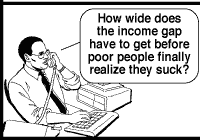
Currently bloviating again about how "Florida and Michigan should count." And yet one of her main bloviator-toadies, Terry "Fullas#i+" McAuliffe, when he was DNC Chairman, once threatened to strip Michigan of half its delegates if they moved their primary too early.
"They thought I was bluffing. But it was my responsibility as chairman to take action for the good of the party, and taking away half their delegates was well within my authority...The whole primary calendar was in danger of spinning out of control."
-- Terry "Fullas#i+" McAuliffe
Showing posts with label hillary clinton talks loud and says nothing. Show all posts
Showing posts with label hillary clinton talks loud and says nothing. Show all posts
Tuesday, May 13, 2008


Monday, April 21, 2008
Keep 'em coming
Clinton: Obama would be 'leap of faith'
Whereas you or McCain are 'sure bets'? Please, pretty please, Pennsylvania, please put this plutocrat out of here misery and put the faith in democracy back in da Fungster. Please?
Whereas you or McCain are 'sure bets'? Please, pretty please, Pennsylvania, please put this plutocrat out of here misery and put the faith in democracy back in da Fungster. Please?
Friday, January 25, 2008
Next Shocker: A Picture of Fung and Tony Rezko
"Today" show host Matt Lauer asked presidential hopeful Hillary Clinton on Friday if she has a connection to indicted developer Tony Rezko after flashing an undated photo of the two posing with President Bill Clinton.
"You were attacking Senator Obama, in particular, his work connected to what was a so-called a slumlord in Chicago, a guy named Tony Rezko," Lauer said. "You can't see what I'm going put up on the screen ... but it is a picture of you and your husband Bill Clinton posing with that same man."

"You were attacking Senator Obama, in particular, his work connected to what was a so-called a slumlord in Chicago, a guy named Tony Rezko," Lauer said. "You can't see what I'm going put up on the screen ... but it is a picture of you and your husband Bill Clinton posing with that same man."
Tuesday, January 8, 2008
Clinton tears
Not to be confused with crocodile tears.
Somewhere, let the goddamn cartelists light their cigars and congratulate each other. One of them won in New Hampshire.
Put it this way, if Rupert Murdoch were to vote in the next election, he would pick Hillary over two of the top three Refucklicans running...
But goddamn, she can do exactly what the pollsters tell her...
Monday, December 24, 2007
"It does not go far enough"
It's like baseball managers...From Frank Rich's Sunday column at the New York Times:
Whatever Mrs. Clinton’s experience as first lady or senator, what matters most in any case is not its sheer volume, that 35 years she keeps citing. It’s what she did or did not learn along the way that counts. That’s why one of the most revealing debate passages so far came in an exchange that earned much laughter but scant scrutiny this month in Des Moines.
This was the moment when Mr. Obama was asked how he could deliver a clean break from the past while relying on “so many Clinton advisers.” Mrs. Clinton jokingly called out, “I want to hear that,” prompting Mr. Obama to one-up her by responding, “Well, Hillary, I’m looking forward to you advising me, as well.”
Well, touché. But what was left unexamined beneath the levity was a revealing distinction between these two candidates. The questioner was right: Mr. Obama, like Mrs. Clinton, has indeed turned to former Clintonites for foreign-policy advice. But the Clinton players were not homogeneous, and who ended up with which ’08 candidate is instructive.
The principal foreign-policy Clinton alumni in Mr. Obama’s campaign include Susan Rice, a former assistant secretary of state, and Tony Lake, the former national security adviser and a prewar skeptic who said publicly in February 2003 that the Bush administration had not made the case that Saddam was an “imminent threat.” Ms. Rice, in an eloquent speech in November 2002, said that the Bush administration was “trying to change the subject to Iraq” from the war against Al Qaeda and warned that if it tried to fight both wars at once, “one, if not both, will suffer.” Her text now reads as a bookend to Mr. Obama’s senatorial campaign speech challenging the wisdom of the war only weeks earlier that same fall.
Mrs. Clinton’s current team was less prescient. Though it includes one of the earlier military critics of Bush policy, Gen. Wesley Clark, he is balanced by Gen. Jack Keane, an author of the Bush “surge.” The Clinton campaign’s foreign policy and national security director is a former Madeleine Albright aide, Lee Feinstein, who in November 2002 was gullible enough to say on CNBC that “we should take the president at his word, which is that he sees war as a last resort” — an argument anticipating the one Mrs. Clinton still uses to defend her vote on the Iraq war authorization.
In late April 2003, a week before “Mission Accomplished,” Mr. Feinstein could be found on CNN saying that he was “fairly confident” that W.M.D. would turn up in Iraq. Asked if the war would be a failure if no weapons were found, he said, “I don’t think that that’s a situation we’ll confront.” Forced to confront exactly that situation over the next year, he dug in deeper, co-writing an essay for Foreign Affairs (available on its Web site) arguing that “the biggest problem with the Bush pre-emption strategy may be that it does not go far enough.”
Subscribe to:
Posts (Atom)