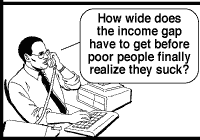
He's for cutting people off unemployment insurance (LAZY PHOKKS), while extending tax cuts for these guys and these guys and these guys (the deserving rich). Thanks, Tea Partiers, for bringing us your not-treading-on-me brand of freedom!
~
Showing posts with label trickle-on economics. Show all posts
Showing posts with label trickle-on economics. Show all posts
Thursday, November 18, 2010


Tuesday, October 28, 2008
from the LoC archives: a short recent history of redistribution of wealth

March 12: According to the latest available statistics from the Internal Revenue Service, the top 1 percent of Americans earned significantly more income in 2005 than the bottom 50 percent. In addition, the Congressional Budget Office (CBO) recently reported that the wealthiest 1 percent saw total income rise by $180,000 in 2005. That is more than the average middle-class family makes in three years. The CBO also found that the total share of after-tax income going to the top 1 percent hit the highest level on record, while the middle class and working families received the smallest share of after-tax income on record.
May 5: The gap between rich and poor in the United States has widened exponentially over the past three decades. The Congressional Budget Office reports that since 1979, the average income for the bottom half of American households has grown by 6 percent. In contrast, the top 1 percent of earners have seen their incomes shoot up by a 229 percent during that same period. Under the Bush administration, the average income of most Americans has fallen, but the average income of top wage earners (those above the 95 percentile range) has increased from $324,427 in 2001 to $385,805 in 2006. Only one other year has seen a comparable income gap: 1928, the year before the Great Depression.
October 21: Yet seven years into this economic cycle, most middle-class American households (aka, the WHINERS... Ed.) have less inflation-adjusted income than they had when it started...
The exception in compensation gains was for the top 1 percent of earners, who have considerably widened the pay gap between themselves and other workers. (YAY! Ed.)
So it's not the concept of redistributing wealth that Republicans have a problem with. They're just concerned that it keeps getting redistributed in the right direction.

Tuesday, October 21, 2008
we must fix the economy in time to secure the gains made by our Noble Plutocrats
Workers reap few benefits as U.S. productivity grows
Since the 2001 recession, the American work force has contributed to a robust 20 percent growth in productivity, as measured by the gross national product.
Yet seven years into this economic cycle, most middle-class American households (aka, the WHINERS... Ed.) have less inflation-adjusted income than they had when it started...
Particularly notable about the stagnant pay is that it affected not just the lowest-paid or least-skilled, but college-degreed, professional workers as well.
The exception in compensation gains was for the top 1 percent of earners, who have considerably widened the pay gap between themselves and other workers. (YAY! Ed.)
Since the 2001 recession, the American work force has contributed to a robust 20 percent growth in productivity, as measured by the gross national product.
Yet seven years into this economic cycle, most middle-class American households (aka, the WHINERS... Ed.) have less inflation-adjusted income than they had when it started...
Particularly notable about the stagnant pay is that it affected not just the lowest-paid or least-skilled, but college-degreed, professional workers as well.
The exception in compensation gains was for the top 1 percent of earners, who have considerably widened the pay gap between themselves and other workers. (YAY! Ed.)
Friday, September 19, 2008
this is probably nothing to worry about
we are now seeing what happens when a 20 to 21 percent of GDP financial sector starts to come unglued... never had so much polarization and wealth disparity and just groaning wealth right at the top of ladder as we have now... the central component of the rise of the financial sector is the rise of the debt industry... it's a package which Americans have to understand is going to be awful... seven sharks in the tank with the economy... first is financialization because we're so dependent on this industry that's sort of half lost its marbles... second is that you have this huge buildup of debt, absolutely unprecedented anywhere in the world... third is you've now got home prices collapsing... fourth is you've got global commodity inflation building up... fifth is you've got flawed and deceptive government economics statistics... sixth is that you've got what they call peak oil where the world is, to some extent, running out of oil... last thing is the collapsing dollar... whenever you get this sort of package in one decade, you got a big one... another variation but on a par with the Thirties... The British were absolutely top dog in the world in 1914. Two world wars and 35 years later, they were having, after World War II, they were having food rationing, the pound sterling crashed, dukes were giving guided tours of their castles because they couldn't afford to maintain them otherwise. Doesn't take long. And I'm afraid the United States is coming right into that period which marks a couple of decades coming up that are going to be very difficult for America.
Friday, August 8, 2008
Well, you know what Ohio will vote for: more of the same economic policy via McBush III
America's Fastest-Dying Cities
Washington, D.C. - The turmoil of the mortgage market granted a temporary reprieve from hearing about the woes of America's Rust Belt. That doesn't mean things are better. Despite a decade of national prosperity (huh??--ed.), the former manufacturing backbone of the U.S. is in rougher shape than ever, still searching for some way to replace its long-stilled smokestacks.
Where's it worst? Ohio, according to our analysis, which racked up four of the 10 cities on our list: Youngstown, Canton, Dayton and Cleveland. The runner-up is Michigan, with two cities--Detroit and Flint--making the ranking.
~
Washington, D.C. - The turmoil of the mortgage market granted a temporary reprieve from hearing about the woes of America's Rust Belt. That doesn't mean things are better. Despite a decade of national prosperity (huh??--ed.), the former manufacturing backbone of the U.S. is in rougher shape than ever, still searching for some way to replace its long-stilled smokestacks.
Where's it worst? Ohio, according to our analysis, which racked up four of the 10 cities on our list: Youngstown, Canton, Dayton and Cleveland. The runner-up is Michigan, with two cities--Detroit and Flint--making the ranking.
~
Wednesday, May 21, 2008
Plutocrats: Unhinged (cont'd)
QT Trickle-On Economics Update:
A Philadelphia restaurant announced a $100 Philly cheesesteak sandwich that includes Kobe beef, butter-poached lobster and shaved truffles as Pennsylvania food banks started turning away people because of short supplies.
A Philadelphia restaurant announced a $100 Philly cheesesteak sandwich that includes Kobe beef, butter-poached lobster and shaved truffles as Pennsylvania food banks started turning away people because of short supplies.
Monday, April 21, 2008
I'm sure the Cubs are pulling this scam, too--someone get Greg Couch on da case
Beer is high on price, low on alcohol content
Padres fans already know beer sold at Petco Park has a higher price tag than the same thing elsewhere. But they might be surprised to learn some of the beer also has lower alcohol content. Three of the downtown ballpark's domestic draft brands – Budweiser Select, Miller Lite and Miller Genuine Draft – contain 3.2 percent alcohol by weight. Go to a bar and most regular domestic draft beer will have about 4 percent alcohol by weight. Most light beers run about 3.4 percent.
Padres officials say lower-alcohol beer, like higher prices, is part of an “alcohol management plan,”* meant to keep fans from overindulging. They also say it's common practice in the sports industry and hardly limited to Petco.
[*aka "ripoff manangement plan"...]
The difference in cost is 32 percent. A keg of Budweiser Select goes for $76, according to California Department of Alcoholic Beverage Control records. The 3.2 percent version of Bud Select runs $52.
But today's higher beer prices could make the lower alcohol content harder to swallow. In 1988, a beer at a Padres game was $2. When adjusted for inflation, that $2 beer would be $3.61 today. The cheapest beer at Petco now is a 16-ounce domestic draft for $6.50.
Of course, if you're dumb enough to drink budmillerscoors swill and pay $8.50 for it, you're probably not gonna notice, or care.
Friday, March 21, 2008
What Happens When It Turns Out "The Man" Is Woodchuck Smart?
From the wacky leftist-commo rag the New York Times comes a screed against the brave new world of commerce and banking created by forward thinking and actionable men who pushed beyond the stars into whole new worlds of heady profit and genius.
Why is it government that's always called short-sighted and ignorant? Bureaucratic, ok, and sometimes that sucks, but how is this any better? It's not. These men are fucking idiots and they are breaking things. They should not be allowed near these things, and many of them should be in jail. And all of them should get a good swift kick through the ass:
"Not a week goes by that the Fed doesn’t inaugurate a new way to provide liquidity — meaning money — to the financial system. Bear Stearns isn’t enormous. It doesn’t take deposits from the public. Yet the Fed believed that letting it implode could unleash a domino effect among other banks, and the Fed provided a $30 billion guarantee for JPMorgan to snap it up.
Compared to the cold shoulder given to struggling homeowners, the cash and attention lavished by the government on the nation’s financial titans provides telling insight into the priorities of the Bush administration. It’s not simply a matter of fairness, though. The Fed is probably right to be doing all it can think of to avoid worse damage than the economy is already suffering. But if the objective is to encourage prudent banking and keep Wall Street’s wizards from periodically driving financial markets over the cliff, it is imperative to devise a remuneration system for bankers that puts more of their skin in the game.
Financiers, of course, dispute that they are being insufficiently penalized. “I received no bonus for 2007, no severance pay, no golden parachute,” E. Stanley O’Neal, the former chief executive of Merrill Lynch, told a House committee recently. That doesn’t seem like much of a blow to Mr. O’Neal, who was removed earlier this year following gargantuan subprime-related losses."
Why is it government that's always called short-sighted and ignorant? Bureaucratic, ok, and sometimes that sucks, but how is this any better? It's not. These men are fucking idiots and they are breaking things. They should not be allowed near these things, and many of them should be in jail. And all of them should get a good swift kick through the ass:
"Not a week goes by that the Fed doesn’t inaugurate a new way to provide liquidity — meaning money — to the financial system. Bear Stearns isn’t enormous. It doesn’t take deposits from the public. Yet the Fed believed that letting it implode could unleash a domino effect among other banks, and the Fed provided a $30 billion guarantee for JPMorgan to snap it up.
Compared to the cold shoulder given to struggling homeowners, the cash and attention lavished by the government on the nation’s financial titans provides telling insight into the priorities of the Bush administration. It’s not simply a matter of fairness, though. The Fed is probably right to be doing all it can think of to avoid worse damage than the economy is already suffering. But if the objective is to encourage prudent banking and keep Wall Street’s wizards from periodically driving financial markets over the cliff, it is imperative to devise a remuneration system for bankers that puts more of their skin in the game.
Financiers, of course, dispute that they are being insufficiently penalized. “I received no bonus for 2007, no severance pay, no golden parachute,” E. Stanley O’Neal, the former chief executive of Merrill Lynch, told a House committee recently. That doesn’t seem like much of a blow to Mr. O’Neal, who was removed earlier this year following gargantuan subprime-related losses."
Friday, February 22, 2008
EMPTY YOUR BANK ACCOUNTS TODAY!
Cubs tickets on sale
1:32 PM CST, February 22, 2008
MESA, Ariz. - Tickets for individual Cubs games went on sale at 8 a.m. Friday at Wrigley Field, at 10 a.m. at http://www.cubs.com/ and at 10 a.m. via phone at 800-843-2827 or 866-652-2827 (out of state).
1:32 PM CST, February 22, 2008
MESA, Ariz. - Tickets for individual Cubs games went on sale at 8 a.m. Friday at Wrigley Field, at 10 a.m. at http://www.cubs.com/ and at 10 a.m. via phone at 800-843-2827 or 866-652-2827 (out of state).
Friday, February 8, 2008
dere is annudder doomsday direkkly behind dis one
Doomsday plan would close 2 Cook hospitals
All 12 of county's neighborhood clinics also would be shut
(Crain’s) — Cook County would close two of its three hospitals and a center that treats one-third of the area’s HIV patients under a doomsday budget scenario officials put forth Friday.
All 12 of county's neighborhood clinics also would be shut
(Crain’s) — Cook County would close two of its three hospitals and a center that treats one-third of the area’s HIV patients under a doomsday budget scenario officials put forth Friday.
Wednesday, January 30, 2008
East Coast asshole opens luxury hotel here
News item: Travelers who want to be the first to sleep at Donald Trump’s new Chicago hotel Wednesday will pay $325 to $1,425 for the privilege...
Those are the posted rates for the 339-room riverside inn, which will take on the city’s most expensive hotels, a group that includes the Peninsula and Four Seasons...
For $325 a night, a guest can stay in a 600-square-foot unit with a king-sized bed and a kitchen, according the hotel’s Web site. Guests who want more space can pay $1,425 for a 2,140-square-foot suite with two bedrooms, three bathrooms, a kitchen, dining room and lake view...
Those are the posted rates for the 339-room riverside inn, which will take on the city’s most expensive hotels, a group that includes the Peninsula and Four Seasons...
For $325 a night, a guest can stay in a 600-square-foot unit with a king-sized bed and a kitchen, according the hotel’s Web site. Guests who want more space can pay $1,425 for a 2,140-square-foot suite with two bedrooms, three bathrooms, a kitchen, dining room and lake view...
Tuesday, January 29, 2008
we are living in a golden age (cont'd)
QT Trickle-On Economics Update:
Project Feed the Thousands in Vermont fell short of its goal of 7,000 bags of food for the hungry as a fashion designer announced a line of $3,000 python-skin handbags injected with botox to make them softer and plumper.
Project Feed the Thousands in Vermont fell short of its goal of 7,000 bags of food for the hungry as a fashion designer announced a line of $3,000 python-skin handbags injected with botox to make them softer and plumper.
Sunday, October 14, 2007
Can We Do This Just Because We Hate Him?
I can almost hear Bill O'Reilly or a minion yelling in 2011 now...
The Moscow Times
Monday, October 15, 2007. Issue 3764. Page 10.
A Lesson in Russian History for Clinton
By Alexei Bayer
The war in Afghanistan was not the main reason the Soviet Union collapsed. Nevertheless, it bankrupted the Soviet state and pointed out the moral blight, skewed priorities and irrelevance of the Communist gerontocracy.
The United States is a vibrant society with a diversified and resilient economy. But it currently stands on the brink of considerable social and economic upheaval, and the Iraq war reveals the fault lines within the world's only superpower. It is a nation living beyond its means by exploiting the status of the dollar as the global reserve currency. The war is costing some $3 billion per week -- all of it borrowed from more productive nations.
The United States is the leader of the free world, which the rest of the world refuses to follow. Even the pathetic "coalition of the willing," a bunch of mostly third-tier nations Washington assembled to back it in Iraq, has crumbled.
Iraq occupies a far more important place in the political debate in the United States than Afghanistan ever did in the Soviet Union. It is divisive, and frustrations on both sides have been exacerbated by the fact that no victory, however defined, can be achieved. Nor can U.S. forces leave without plunging a strategic, oil-rich region into chaos.
U.S. overconsumption and unilateralism predated President George W. Bush. But it was Bush who turned federal fiscal surpluses into deficits -- literally, with a stroke of a pen -- by granting his disastrous tax cuts. He plunged the United States into the irrelevant global war on terror, started the unnecessary and wasteful war in Iraq and created the moral climate in which Americans stand accused of torture, war crimes and atrocities.
Bush has been called the worst president in U.S. history. But now he has devised a clever plan to rescue his legacy. His troop surge in Iraq is designed to create a sense of stability and even progress. His economic policy, aided and abetted by the U.S. Federal Reserve, has been to stretch the liquidity bubble for another year or so. He could then credibly claim that he left office with Iraq on the mend and the economy booming and that his successors dropped the ball.
The next occupant of the White House will have to fight back in self-defense. He -- or most probably she (meaning Democrat Hillary Clinton, who is currently the most credible candidate) -- should study recent Russian history. Gorbachev withdrew troops from Afghanistan, but he never put those responsible for the war on trial. Boris Yeltsin ended communism and split the Soviet empire, but he avoided pushing for de-Stalinization. Even a symbolic condemnation of communism by Russian courts would have allowed the country to turn over a new page and rejoin the community of nations in much the same way West Germany did after World War II.
As a result, in post-Soviet Russia, Brezhnev's reputation is being revived, Stalin is widely venerated and former KGB officers rule the Kremlin. Gorbachev and Yeltsin, meanwhile, are reviled for "destroying a great country."
If Clinton doesn't want to share their fate -- which in the U.S. context would mean a failed one-term presidency -- she would need to start de-Bushification. Her first act in office should be to put Bush and his entourage on trial.
When I recently suggested this to an audience of New York lawyers, the room exploded with laughter. It would be unconstitutional, they said, and also so un-American, to be stuck in the past.
On the contrary, putting blame where it belongs would be a step toward the future. It would, first of all, extract the next president's reputation from the rubble of failed policies. More important, a guilty verdict passed on the Bush administration by an impartial and independent U.S. court might put an end to unilateralism and restore the United States' rightful place in the community of nations. Both would benefit.
Alexei Bayer, a native Muscovite, is a New York-based economist.
The Moscow Times
Monday, October 15, 2007. Issue 3764. Page 10.
A Lesson in Russian History for Clinton
By Alexei Bayer
The war in Afghanistan was not the main reason the Soviet Union collapsed. Nevertheless, it bankrupted the Soviet state and pointed out the moral blight, skewed priorities and irrelevance of the Communist gerontocracy.
The United States is a vibrant society with a diversified and resilient economy. But it currently stands on the brink of considerable social and economic upheaval, and the Iraq war reveals the fault lines within the world's only superpower. It is a nation living beyond its means by exploiting the status of the dollar as the global reserve currency. The war is costing some $3 billion per week -- all of it borrowed from more productive nations.
The United States is the leader of the free world, which the rest of the world refuses to follow. Even the pathetic "coalition of the willing," a bunch of mostly third-tier nations Washington assembled to back it in Iraq, has crumbled.
Iraq occupies a far more important place in the political debate in the United States than Afghanistan ever did in the Soviet Union. It is divisive, and frustrations on both sides have been exacerbated by the fact that no victory, however defined, can be achieved. Nor can U.S. forces leave without plunging a strategic, oil-rich region into chaos.
U.S. overconsumption and unilateralism predated President George W. Bush. But it was Bush who turned federal fiscal surpluses into deficits -- literally, with a stroke of a pen -- by granting his disastrous tax cuts. He plunged the United States into the irrelevant global war on terror, started the unnecessary and wasteful war in Iraq and created the moral climate in which Americans stand accused of torture, war crimes and atrocities.
Bush has been called the worst president in U.S. history. But now he has devised a clever plan to rescue his legacy. His troop surge in Iraq is designed to create a sense of stability and even progress. His economic policy, aided and abetted by the U.S. Federal Reserve, has been to stretch the liquidity bubble for another year or so. He could then credibly claim that he left office with Iraq on the mend and the economy booming and that his successors dropped the ball.
The next occupant of the White House will have to fight back in self-defense. He -- or most probably she (meaning Democrat Hillary Clinton, who is currently the most credible candidate) -- should study recent Russian history. Gorbachev withdrew troops from Afghanistan, but he never put those responsible for the war on trial. Boris Yeltsin ended communism and split the Soviet empire, but he avoided pushing for de-Stalinization. Even a symbolic condemnation of communism by Russian courts would have allowed the country to turn over a new page and rejoin the community of nations in much the same way West Germany did after World War II.
As a result, in post-Soviet Russia, Brezhnev's reputation is being revived, Stalin is widely venerated and former KGB officers rule the Kremlin. Gorbachev and Yeltsin, meanwhile, are reviled for "destroying a great country."
If Clinton doesn't want to share their fate -- which in the U.S. context would mean a failed one-term presidency -- she would need to start de-Bushification. Her first act in office should be to put Bush and his entourage on trial.
When I recently suggested this to an audience of New York lawyers, the room exploded with laughter. It would be unconstitutional, they said, and also so un-American, to be stuck in the past.
On the contrary, putting blame where it belongs would be a step toward the future. It would, first of all, extract the next president's reputation from the rubble of failed policies. More important, a guilty verdict passed on the Bush administration by an impartial and independent U.S. court might put an end to unilateralism and restore the United States' rightful place in the community of nations. Both would benefit.
Alexei Bayer, a native Muscovite, is a New York-based economist.
Friday, August 31, 2007
The System Works (cont'd)
From USA Today:
To say the pay gap between Wall Street’s top titans and average Americans is widening would be an understatement. One statistic sums up why: Last year, the top 20 hedge-fund and private-equity-fund managers earned more in 10 minutes than U.S. workers made the entire year, according to a report released Wednesday by two research groups. Those top fund managers pocketed an average $657.5 million in 2006, or 22,255 times the $29,544 average annual pay of U.S. workers, said the study issued by the Institute for Policy Studies (IPS) and United for a Fair Economy. That dwarfs the discrepancy between CEOs and workers: Corporate chieftains, on average, earn about 365 times the pay of U.S. workers. (more…)
To say the pay gap between Wall Street’s top titans and average Americans is widening would be an understatement. One statistic sums up why: Last year, the top 20 hedge-fund and private-equity-fund managers earned more in 10 minutes than U.S. workers made the entire year, according to a report released Wednesday by two research groups. Those top fund managers pocketed an average $657.5 million in 2006, or 22,255 times the $29,544 average annual pay of U.S. workers, said the study issued by the Institute for Policy Studies (IPS) and United for a Fair Economy. That dwarfs the discrepancy between CEOs and workers: Corporate chieftains, on average, earn about 365 times the pay of U.S. workers. (more…)
Subscribe to:
Posts (Atom)